In today’s fast-evolving automotive and transport industries, safety is no longer an afterthought; it is a core design priority. Every year, road accidents claim hundreds of thousands of lives worldwide, while vehicle recalls due to structural weaknesses cost manufacturers billions. To address these challenges, designers rely on crash analysis, a sophisticated process that uses simulation, computational modeling, and data-driven insights to design vehicles that are safer, more durable, and compliant with global regulations. At RA Global Tech Solutions, we leverage cutting edge finite element analysis and advanced computer-aided engineering tools to deliver precise crash simulations that guide smarter vehicle design.
Crash analysis, often called crashworthiness assessment, evaluates how a vehicle responds to collision events. Traditionally, vehicle safety was verified through physical crash testing, where prototypes were subjected to frontal, side, and rear collisions. While effective, physical tests are costly, time consuming, and limited in flexibility. Today, engineers combine simulation-based approaches with real world crash data to achieve more accurate and predictive outcomes.
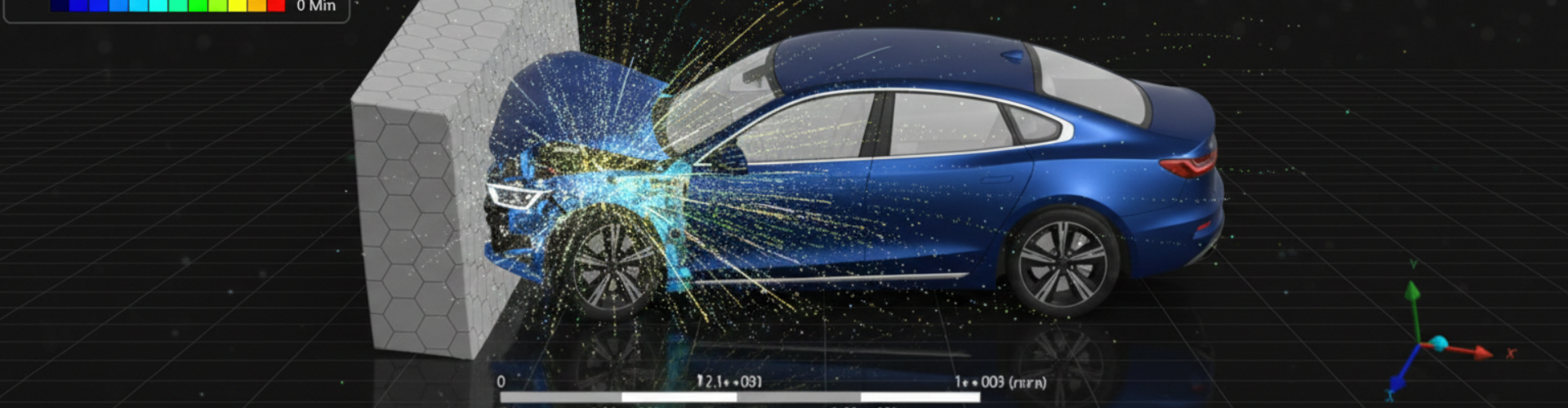
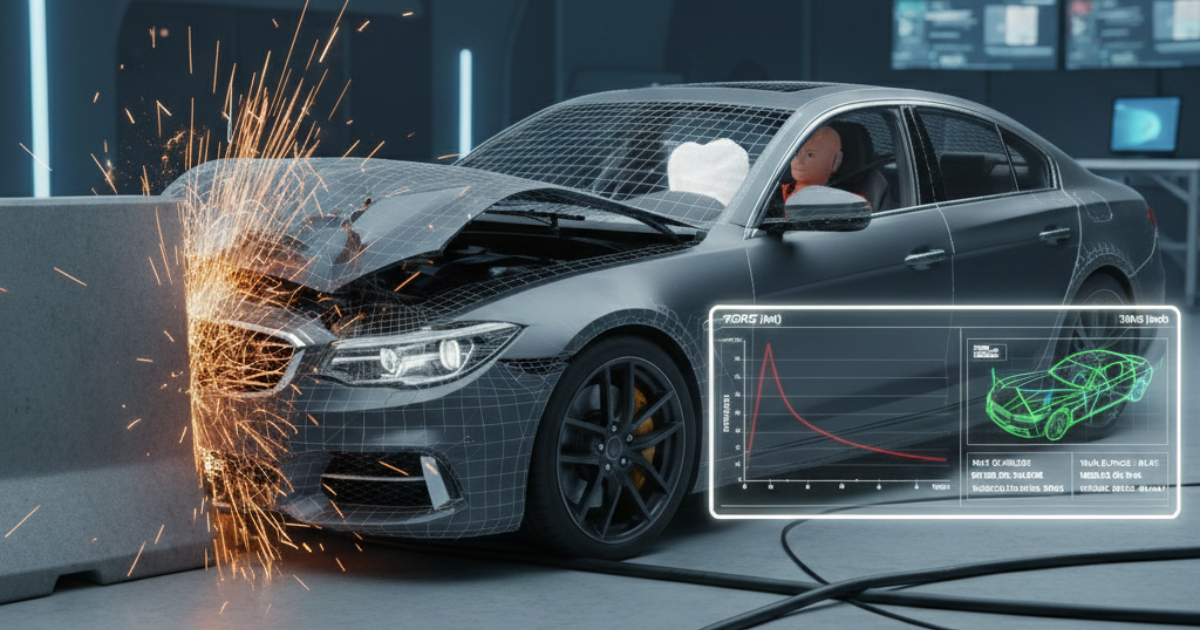
Simulation driven crash analysis uses finite element analysis to create a detailed digital model of a vehicle. Each component, be it the chassis, bumper, or safety cage, is represented with material properties and geometric accuracy. Designers can then apply collision forces in the model and observe how structures deform, how energy is absorbed, and how occupants would respond during an accident.
At RA Global Tech Solutions, we enhance traditional finite element analysis with explicit dynamics solvers, to simulate high speed impacts with precision. This combination allows our clients to optimize vehicle structures before any physical prototype is built, reducing costs while improving safety.
Crash analysis relies on a combination of computational techniques and experimental validation. The most common methods include:
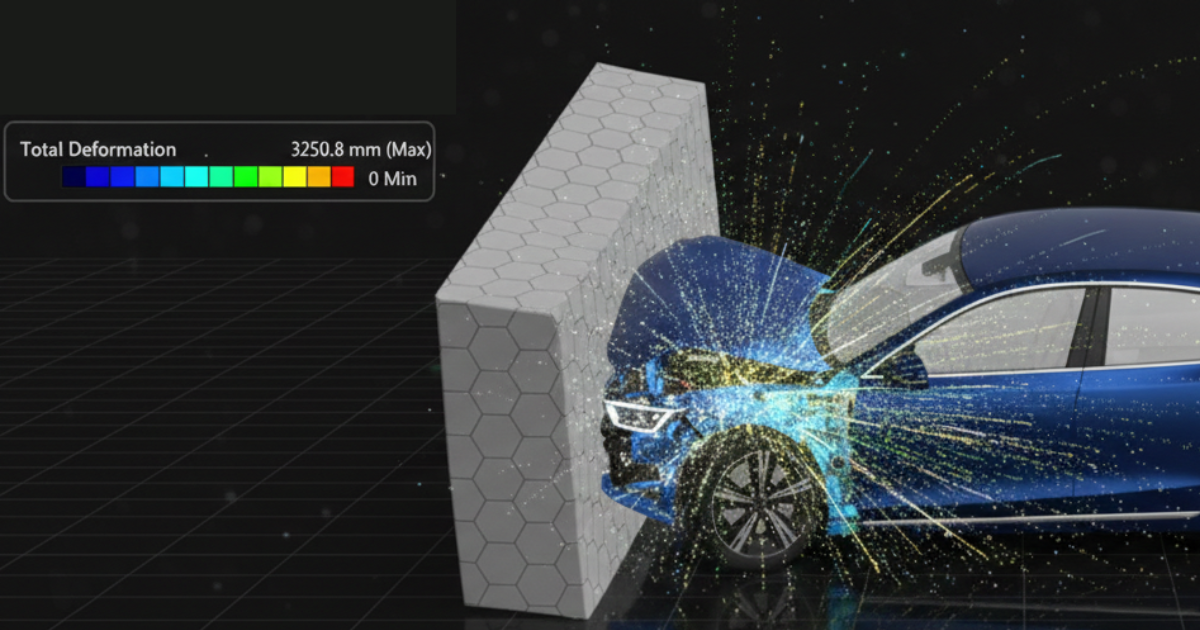
Finite Element Analysis forms the core of modern crash analysis by enabling highly detailed numerical simulations of structural behavior under impact conditions. In this method, the vehicle’s geometry is discretized into a mesh of finite elements interconnected at nodes, where each element is assigned specific material properties such as elasticity, plasticity, density, and strain rate sensitivity. Boundary conditions and contact definitions are applied to replicate real world crash scenarios. During simulation, governing equations of motion are solved to compute stress distribution, strain evolution, deformation patterns, and energy absorption characteristics. This allows engineers to evaluate structural integrity, optimize load paths, and design efficient energy dissipating components like crumple zones while minimizing overall vehicle weight.
Explicit dynamics simulations are specifically designed to handle highly non linear, transient events such as vehicle collisions, where large deformations, high strain rates, and complex contact interactions occur within very short time frames. Unlike implicit methods, explicit solvers use a time integration approach that directly calculates the state of the system at each small time increment without requiring equilibrium iterations, making them computationally efficient for impact problems. These simulations capture critical phenomena such as material failure, fracture propagation, contact impact forces, and dynamic instability, providing realistic predictions of how structures behave during high speed collisions.
Multibody dynamics focuses on the kinematic and dynamic behavior of interconnected rigid or flexible bodies within a mechanical system. In crash analysis, it is used to simulate the motion and interaction of vehicle subsystems such as suspension components, steering mechanisms, and occupant models. By solving equations of motion for multiple bodies connected through joints and constraints, MBD enables the study of system level responses like vehicle trajectory, rollover tendencies, and occupant kinematics during a crash event. When integrated with FEA, multibody dynamics provides a comprehensive understanding of both structural deformation and overall system motion, allowing engineers to evaluate occupant safety, restraint system performance, and crash pulse characteristics more effectively.
In addition to physics based simulations, modern crash analysis increasingly relies on data driven approaches to enhance predictive accuracy and decision making. Large volumes of crash data collected from event data recorders, sensor networks, traffic monitoring systems, and insurance databases are analyzed using advanced statistical techniques and machine learning algorithms. Methods such as regression analysis, clustering, and neural networks help identify hidden patterns, correlations, and risk factors associated with different crash scenarios. Predictive modeling enables engineers to estimate injury severity, assess collision probabilities, and optimize vehicle design parameters accordingly. This integration of data analytics with engineering simulations creates a more robust and intelligent framework for improving vehicle safety and reducing accident risks.
The impact of crash analysis extends far beyond theoretical modeling. Its benefits directly improve vehicle safety, design efficiency, and regulatory compliance.
Safety Improvement
Crash analysis plays a vital role in enhancing road safety by systematically identifying high risk zones such as freeway work areas, intersections, tunnels, and accident prone corridors. By studying historical accident data and on ground conditions, experts can determine common causes such as poor visibility, improper signage, traffic congestion, or unsafe driving behavior. Based on these insights, targeted measures can be implemented, including improved road design, better traffic control systems, enhanced lighting, and stricter law enforcement. In addition, educational campaigns can be developed to raise awareness among drivers, ultimately reducing accident rates and improving overall road safety.
Vehicle Safety Innovation
Crash analysis significantly contributes to the advancement of vehicle safety by helping engineers understand how different components behave under impact conditions. It provides insights into structural strength, energy absorption capacity, and the effectiveness of safety features such as airbags, seatbelts, and crumple zones. By evaluating various crash scenarios, manufacturers can refine vehicle designs to better protect occupants during collisions. This leads to continuous improvement in crashworthiness, ensuring that vehicles are not only compliant with safety standards but also capable of minimizing injury risks in real world situations.
Preventive Data Insight
A key strength of crash analysis lies in its ability to transform raw accident data into meaningful insights. By examining factors such as vehicle speed, lighting conditions, weather, road type, and driver behavior, patterns and correlations can be identified. For example, higher accident rates during nighttime or in adverse weather conditions can highlight the need for better illumination or road surface improvements. These data driven insights enable authorities and engineers to predict potential accident scenarios and take proactive measures, shifting the focus from reactive response to preventive safety planning.
Risk Reduction
Crash analysis provides actionable information that directly supports the reduction of both accident frequency and severity. By integrating findings into vehicle design improvements, infrastructure upgrades, and traffic management strategies, it helps create a safer transportation environment. Measures such as improved vehicle structures, better road layouts, and optimized traffic flow contribute to minimizing the impact of collisions. As a result, the likelihood of severe injuries and fatalities is significantly reduced, making crash analysis a critical tool in building safer and more resilient mobility systems.

Crash analysis is essential not only for passenger vehicles but also for aviation, public transport, and defense applications:
By adopting simulation based methods, industries can design vehicles that not only meet safety standards but also perform optimally under extreme conditions.
Simulation driven crash analysis offers multiple advantages over conventional methods:
RA Global Tech Solutions leverages these benefits to deliver highly reliable crash analysis services across sectors, ensuring clients achieve maximum safety, efficiency, and regulatory compliance.
Despite significant advancements, crash analysis faces challenges:
RA Global Tech Solutions stays at the forefront of these trends, integrating AI, advanced material modeling, and virtual crash simulations to anticipate the needs of next generation vehicles.
Crash analysis has transformed the way vehicles are designed, tested, and certified. By combining FEA, explicit dynamics, and data driven insights, engineers can predict and prevent failures, optimize safety features, and reduce real world injuries.
At RA Global, our expertise in CAE, empowers clients to design safer, lighter, and more efficient vehicles while ensuring compliance with global safety standards. With virtual crash analysis, we are not just improving vehicle safety; we are shaping the future of transportation, where every journey is smarter, safer, and more reliable.
© 2026 RA Global Tech Solutions
Site design and developed by Rajkar Global