India's leading Shock and Vibration Analysis Service Provider
4 Minutes | 14 Sep 2026
Shock analysis is a critical engineering process used to ensure that products and structures can survive sudden impact: high-intensity forces like drops, collisions, or explosions. Unlike standard testing that measures steady weight, this analysis focuses on transient event impacts that happen in fractions of seconds. By studying how a system vibrates and absorbs energy during these sudden impact loads, engineers can identify if a component will shatter instantly or suffer hidden internal damage that might lead to failure later on. This process is essential for creating everything from shock-resistant smartphones to crash-safe vehicles and durable aerospace equipment, ensuring they remain reliable and meet strict safety regulations.
Key Concepts in Shock Analysis
Dynamic Load: Dynamic loads vary with time and are characterized by rapid changes in force or acceleration. In shock events, these loads are typically short-lived but extremely intense, causing significant inertial effects. Accurate representation of dynamic loading is fundamental to predicting component response during impact or sudden excitation.
Shock Response Spectrum (SRS): The Shock Response Spectrum (SRS) is a powerful analytical tool used to quantify how a structure or component responds to shock over a range of natural frequencies. It provides peak response values (acceleration, velocity, or displacement) and is widely used to compare shock severity, assess vulnerability, and guide design decisions without performing full time-history simulations.
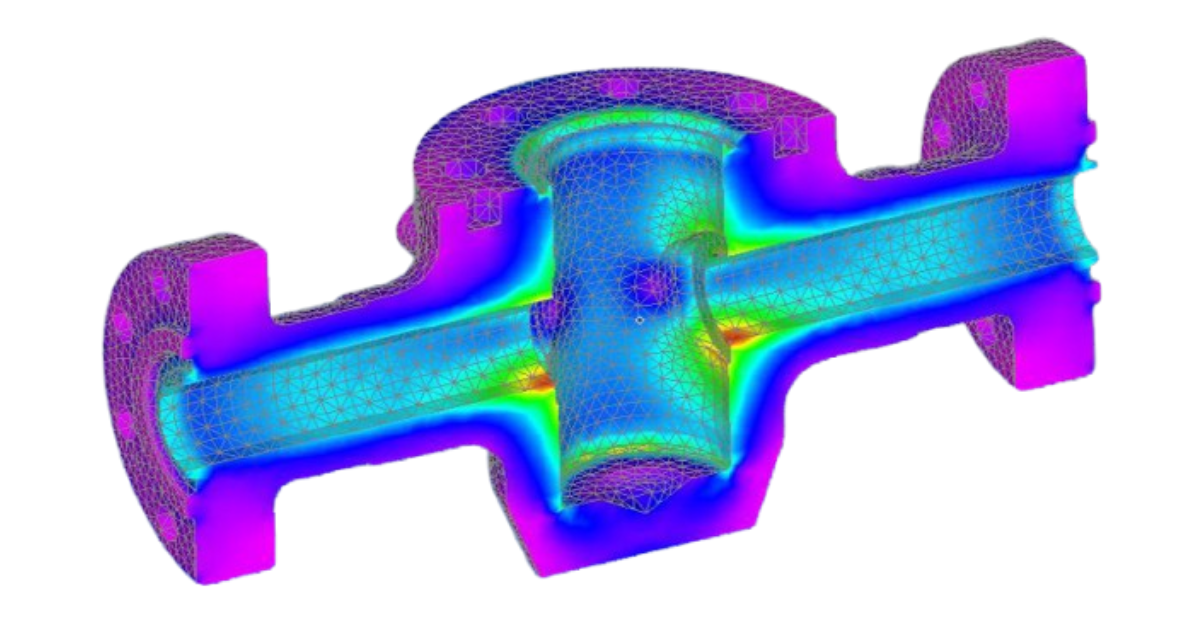
Transient Analysis: Transient analysis evaluates a system’s time-dependent response to shock loads. It captures rapid changes in stress, strain, displacement, and acceleration immediately following a shock event. This analysis is essential for identifying peak responses, stress wave propagation, and potential failure zones within a structure.
Shock Pulses: Shock pulses define the shape, duration, and magnitude of a shock load. Common pulse shapes include half-sine, triangular, rectangular, and sawtooth pulses. Selecting the appropriate pulse type is crucial for realistically simulating real-world shock events and ensuring meaningful analysis results.
Real-World Applications of Shock Analysis
Aerospace and Defense: Shock analysis is vital for aircraft, spacecraft, missiles, and defense equipment exposed to launch loads, landing impacts, weapon firing, and blast events. It ensures mission-critical components maintain structural integrity and functionality under extreme shock conditions. During a rocket launch, satellite electronics experience intense shock when stages separate. Engineers use Shock Response Spectrum (SRS) analysis to verify that circuit boards, sensors, and connectors can withstand acceleration levels reaching thousands of g’s without malfunctioning. If not properly designed, a single shock event could cause mission failure. Example: Modern aircraft landing systems rely on oleo-pneumatic shock struts optimized through real-time simulation and transient analysis. By modeling dynamic energy absorption during touchdown, engineers can fine-tune strut orifice designs and internal pressures. This simulation-driven approach allows for the diagnosis of potential faults and the establishment of critical service thresholds, ensuring the gear provides maximum structural protection during every landing (for more details, see https://arc.aiaa.org/doi/10.2514/3.44526).
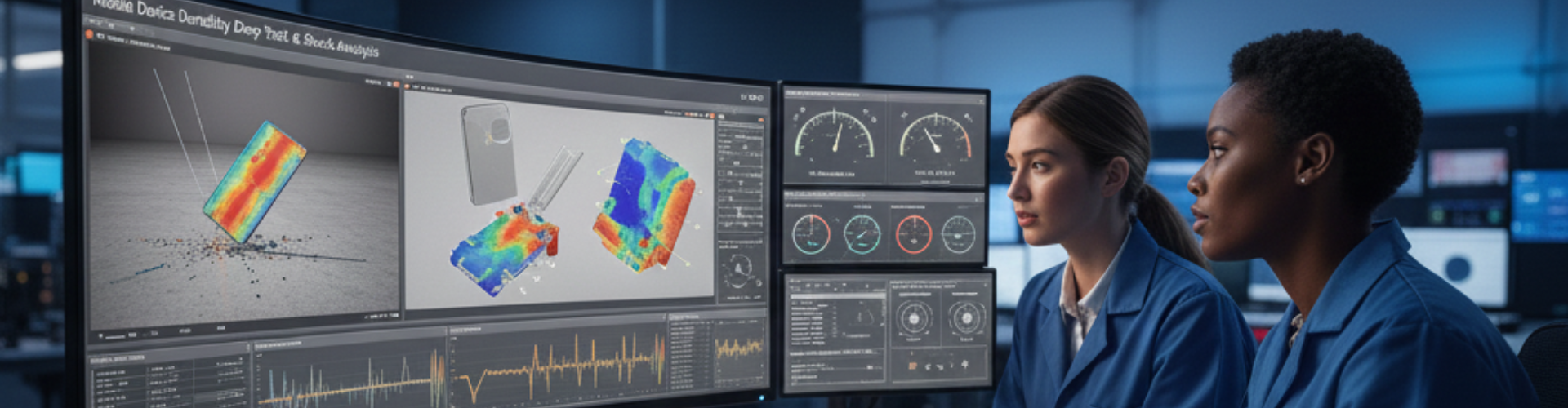
Consumer Electronics: Portable electronic devices are frequently subjected to drops and impacts during handling and transportation. Shock analysis helps protect sensitive components such as circuit boards, sensors, and batteries, improving product durability and reducing warranty failures. When a smartphone is dropped from a height of 1–1.5 meters, the impact generates a short-duration shock pulse. Engineers simulate this drop using transient shock analysis to assess stresses on the display glass, battery, and PCB. Based on results, rubber gaskets, shock-absorbing frames, or reinforced glass are added to reduce failure rates. Example: OPPO F27 Pro+ 5G / F29 Series / A5 Pro 5G / A6 Pro 5G: These phones boast IP69, IP68, and IP66 ratings, meaning they survive high-pressure, hot water jets (IP69), prolonged water submersion (IP68), and heavy splashes (IP66).
Automotive: In the automotive sector, shock analysis is applied to crash scenarios, road-induced impacts, and sudden load changes. It supports the design of safer vehicles by improving the performance of structural components, mounting systems, and safety devices. When a car hits a deep pothole at high speed, suspension components experience a sharp vertical shock. Engineers analyze this event to evaluate peak stresses in control arms and mounting brackets. The results help optimize material thickness and geometry, preventing cracks or long-term fatigue failures. Vehicle safety represents one of CAE's most crucial applications for the passengers' safety during a crash. Brands like Tata Harrier/Safari, Mahindra XUV300, Tata Nexon, Mahindra Thar, Skoda Kushaq, VW Taigun, Hyundai Verna, Tata Curvv, Kia Syros, and Mahindra XUV 400 EV go under rigorous CAE and physical testing for the safety of the passengers. RA Global Tech Solution LLP focuses on structural, thermal, and crash simulations, improving product performance. India’s leading FEA, structural, and performance analysis service provider.
Civil Engineering: Civil structures such as bridges, buildings, and industrial facilities may experience shock loads from seismic activity, accidental impacts, or explosions. Shock analysis helps engineers evaluate structural resilience and develop designs that enhance public safety. In a bridge pier impacted by a heavy truck, the structure experiences a sudden impulse load and chances of resonance. Engineers perform shock and transient analysis to study stress wave propagation through the concrete reinforcement and metal structure. This helps determine whether protective barriers or energy-absorbing layers are required to prevent catastrophic damage.
Engineering and Design Significance
Failure Prediction: Shock analysis enables engineers to identify potential failure modes such as yielding, fracture, or fatigue initiation caused by high-rate loading. RA Global helps with early prediction with CAE, which prevents catastrophic failures and improves system reliability.
Design Optimization: By understanding shock response, engineers can optimize material selection, geometry dimensions, damping, and mounting strategies. This leads to lighter, stronger, and more cost-effective designs without compromising performance or safety. RA Global helps improve design optimization by using CAE tools and expertise.
Regulatory Compliance: Many industries must comply with strict standards and testing requirements related to shock and impact (e.g., military, aerospace, automotive). Shock analysis supports certification processes by demonstrating that products meet required safety and performance criteria.
With over 20 years of experience in CAE and product design, RA Global helps industries across the globe ensure their designs can withstand unexpected loads in various environments or systems. Our expertise in advanced shock analysis enables you to launch products that are built to last.
Transient and Dynamic Finite Element Analysis (FEA): Evaluate structural response under time-dependent, high-magnitude loading by simulating drop, impact, crash, and resonance events. These analyses capture inertia effects, modal participation, and transient stress–strain evolution to ensure dynamic stability and structural robustness.
Shock Response Spectrum (SRS) Analysis: Verify the survivability and functional integrity of sensitive components and complex assemblies subjected to extreme acceleration and short-duration shock environments (like earthquakes, impacts, and vibration) by plotting their peak acceleration against their natural frequency to find potential failure and stresses on the system or civil structure.
Non-Linear Material and Contact Modeling: Accurately predict large deformation, plasticity, damage initiation, and failure by incorporating non-linear constitutive models, strain-rate dependency, and advanced contact algorithms for realistic energy absorption behavior.
Design Optimization and Damping Integration: Enhance product durability and operational lifespan through mathematical and computational tools to systematically reduce the unwanted stresses to achieve the optimized design for the systems. RA Global offers industry-leading engineering analysis and optimization services in India and across the globe.
Aerospace and Defense, Automotive, Consumer Electronics, and Heavy Industry, we help you ensure reliability and performance in extreme scenarios. By combining advanced CAE with shock analysis, we help you innovate faster and safer. With 20+ years of expertise, we turn high-risk variables into calculated certainties. Upgrade your product development process with RA Global Tech Solution LLP.