
Understanding how materials behave under force is essential in mechanical engineering. Two fundamental concepts stress and strain help engineers evaluate material performance, predict failure, and design reliable components. While stress represents the force applied to a material, strain describes how the material responds to that force.
To take this analysis further, engineers use Finite Element Analysis a powerful simulation technique that breaks complex components into smaller elements to study how stress and strain are distributed under real world conditions. FEA allows engineers to visualize weak points, optimize designs, and reduce the need for costly physical prototypes. By combining the fundamentals of stress and strain with FEA, engineers can ensure safer, more efficient, and high performance designs across industries.
In mechanical terms, stress is the internal resistance of a material to an external force, expressed as force per unit area. When a load is applied, the material develops internal forces to resist deformation. There are three primary types of stress. Tensile stress occurs when a material is stretched, compressive stress occurs when it is squeezed or compacted, and shear stress develops when forces act parallel but in opposite directions, causing layers to slide against each other. Understanding these stress types is critical for selecting materials that can withstand real world loading conditions.
Stress is most commonly measured through controlled mechanical testing, where materials are subjected to forces until deformation or failure occurs. The most widely used method is tensile testing, in which a standardized specimen is pulled until it breaks, providing insights into yield and ultimate tensile strengths. Compression testing is used to evaluate how materials behave under compressive loads, particularly for materials such as concrete and ceramics. Shear testing assesses the ability of materials, adhesives, or joints to resist sliding forces, which is especially important in structural and automotive applications. Flexural testing, on the other hand, measures a material’s resistance to bending by applying a load at its center while supported at both ends. These methods together provide a complete understanding of how materials handle stress in different scenarios.
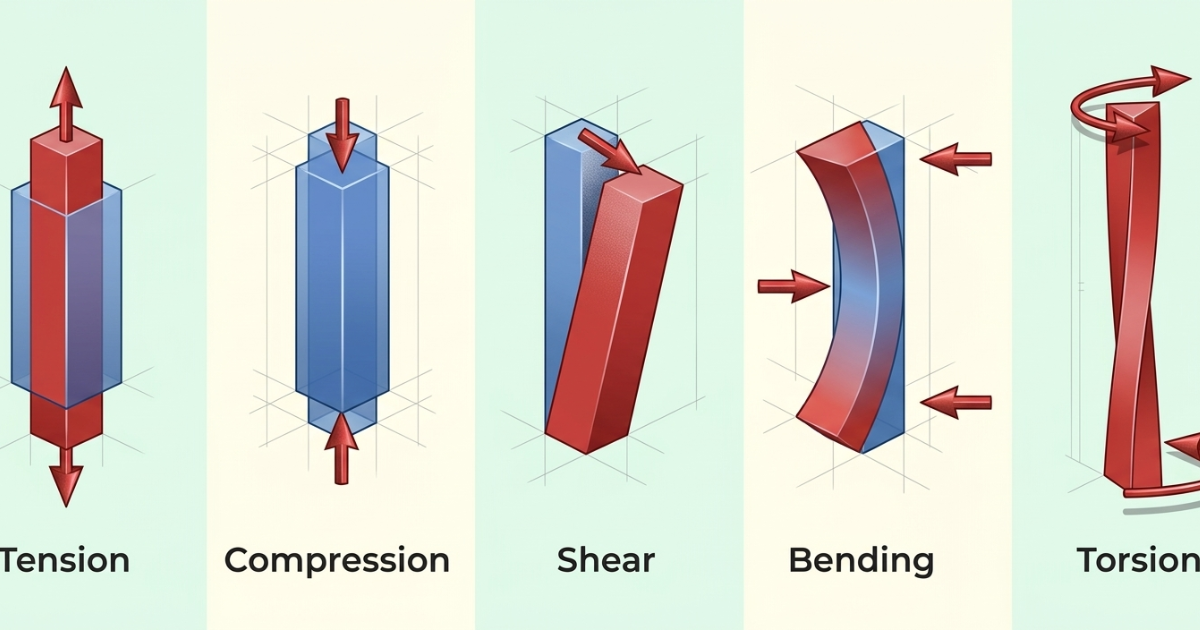
Tension stress occurs when a material is subjected to equal and opposite pulling forces along its length, causing it to stretch or elongate. This type of stress develops internally as the material resists the applied force, and it is directly proportional to the applied load and inversely proportional to the cross sectional area. Under tension stress, materials experience an increase in length and a reduction in cross sectional area, a phenomenon known as necking before failure. This type of stress is critical in applications such as cables, rods, and structural members like bridge supports, where the material must withstand pulling forces without breaking. Understanding tension stress helps engineers determine a material’s ultimate tension strength and its ability to deform elastically or plastically before fracture.
Compressive stress arises when a material is subjected to forces that push or squeeze it, resulting in a reduction in length. Unlike tensile stress, compressive forces cause the material to compact, and if the load exceeds a certain limit, it may lead to buckling rather than direct crushing, especially in slender structures. This type of stress is commonly observed in columns, pillars, and load bearing walls, where materials must resist deformation under heavy loads. Materials under compression tend to expand laterally, and their behavior depends on factors such as geometry, boundary conditions, and material properties. Engineers must carefully analyze compressive stress to prevent sudden failures, particularly in structural and mechanical design.
Shear stress occurs when forces are applied parallel to the surface of a material, causing internal layers to slide against each other. This stress is different from tensile and compressive stresses, as it acts tangentially rather than perpendicularly to the surface. Shear stress is commonly encountered in components such as bolts, rivets, and shafts, where forces attempt to cut or distort the material along a plane. The resistance to shear determines how well a material can maintain its shape without undergoing permanent deformation or fracture. Materials subjected to excessive shear stress may fail by slipping along internal planes, making it essential to consider shear strength in design applications involving fasteners and joints.
Bending stress is a combination of tensile and compressive stresses that occur when a load is applied perpendicular to the axis of a structural element, such as a beam. When bending takes place, one side of the material experiences tensile stress, while the opposite side undergoes compressive stress. Between these two regions lies a neutral axis, where the stress is zero. The magnitude of bending stress depends on factors such as the applied load, the length of the beam, and its cross sectional geometry. This type of stress is critical in structures like bridges, cantilevers, and machine components, where improper design can lead to excessive deflection or failure.
Torsional stress is a specific type of shear stress that occurs when a material is subjected to a twisting force or torque about its longitudinal axis. This stress causes the material to experience angular deformation, with different sections rotating relative to each other. Torsional stress is commonly seen in shafts, axles, and rotating machine elements that transmit power. The magnitude of torsional stress depends on the applied torque, the radius of the shaft, and the material’s properties. If the torsional load exceeds the material’s strength, it may lead to shear failure along a helical plane. Proper analysis of torsional stress is essential to ensure the safe and efficient operation of mechanical systems involving rotational motion.
Hoop stress, also known as circumferential stress, is the tensile stress that acts along the circumference of a cylindrical or spherical pressure vessel when it is subjected to internal pressure. This stress acts perpendicular to both the longitudinal axis and the radius of the vessel, effectively trying to expand or burst the structure outward. In cylindrical vessels such as pipes, tanks, and boilers, hoop stress is typically the most critical stress because it is higher than longitudinal stress and tends to cause the vessel to split along its length. Due to this, hoop stress is often the primary factor considered in the design and failure analysis of pressure vessels.
Strain refers to the deformation a material undergoes when subjected to stress. It is defined as the ratio of the change in dimension to the original dimension, making it a dimensionless quantity. Strains can be broadly categorized into two types. Elastic strain is temporary, meaning the material returns to its original shape once the load is removed. Plastic strain, however, is permanent and occurs when the material is stressed beyond its elastic limit. Understanding these behaviors is essential for determining whether a material will recover or permanently deform under load.
Strain is measured using specialized instruments that track deformation during testing. Extensometers are commonly used in tensile tests to measure elongation accurately. Strain gauges are attached to the material surface to detect small deformations, especially in compression or structural applications. In flexural testing, strain is evaluated by measuring deflection when a material bends under load. Thermal strain testing examines how materials expand or contract due to temperature changes, which is critical in aerospace and electronics. Creep testing measures how a material deforms over time under constant load, particularly in high temperature environments such as turbines. These methods help engineers understand both immediate and long term material behavior.
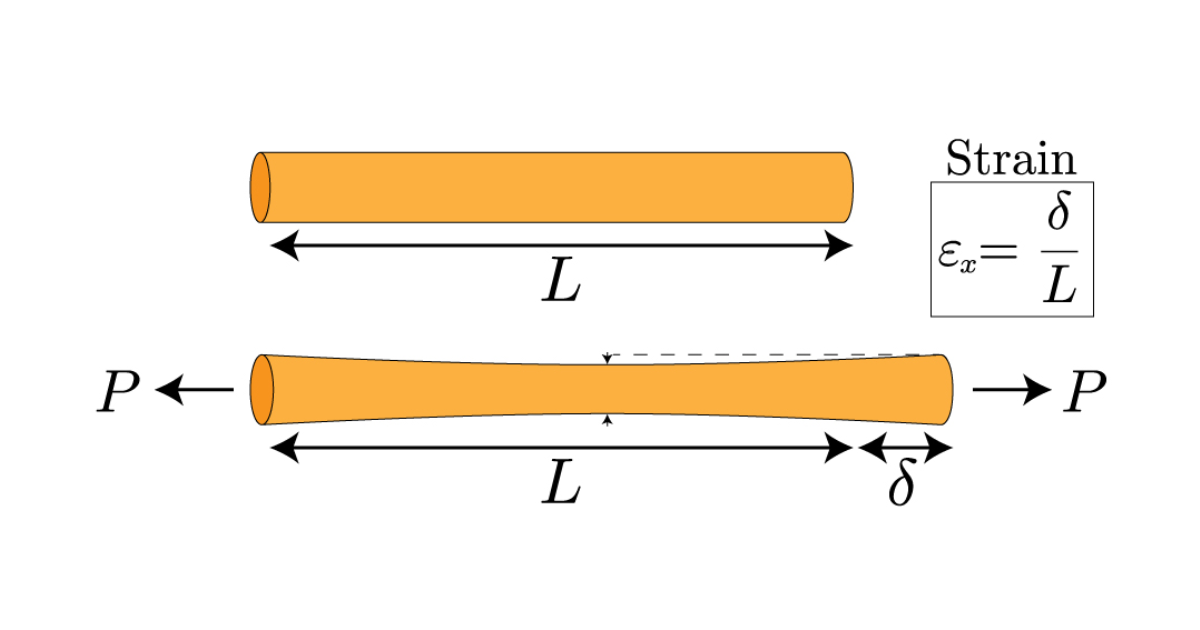
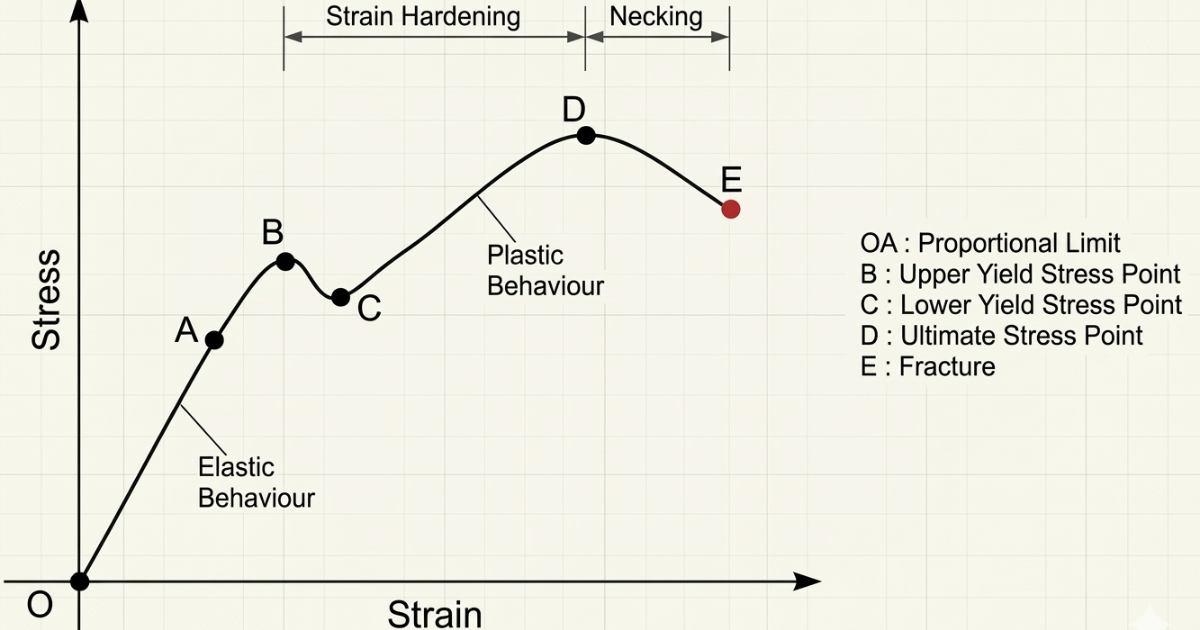
Stress and strain are closely related and together describe how materials behave under load. Stress represents the applied force, while strain represents the resulting deformation. In the elastic region, stress and strain are directly proportional, meaning the material will return to its original shape once the load is removed. This relationship is governed by Hooke’s Law. However, once the stress exceeds a certain limit known as the yield point, the material enters the plastic region, where deformation becomes permanent. The maximum stress a material can withstand before failure is called the ultimate tensile strength. This relationship is fundamental for predicting how materials will perform in real world applications.
In the initial stage of loading, known as the elastic region, stress and strain are directly proportional. This means that as the applied stress increases, the strain increases linearly. In this region, the material behaves elastically and will return to its original shape once the load is removed. This linear relationship is defined by Hooke’s Law:
σ=Eε
where σ is stress, ε is strain, and E is Young’s Modulus, a property that indicates the stiffness of the material.
Principal stress represents the extreme values of normal stress, maximum and minimum that act at a specific point within a material under complex loading conditions. In real world engineering applications, materials are rarely subjected to a single force; instead, they experience a combination of stresses in multiple directions along with shear stresses. This creates a complex stress state. However, by transforming the coordinate system, it is always possible to find particular planes where shear stress becomes zero, and only normal stresses act. These normal stresses on those planes are known as principal stresses, and they are critical in identifying the most vulnerable points in a material.
The determination of principal stress is essential because it simplifies a complicated stress system into a more understandable form. Engineers use it to identify the maximum stress a material experiences, which directly relates to failure theories. If the maximum principal stress exceeds the material’s strength, failure such as cracking or fracture is likely to occur. Therefore, analyzing principal stress helps in predicting failure and ensuring safe and efficient design of components like beams, shafts, pressure vessels, and machine parts.
Understanding maximum principal stress is particularly important in failure analysis. It indicates the highest tensile stress the material experiences, which is often the primary cause of brittle failure. In structural and mechanical design, engineers rely on this value to ensure that the working stress remains well below the material’s allowable limit. Proper evaluation of principal stress not only improves design efficiency but also enhances safety, durability, and reliability of engineering systems.
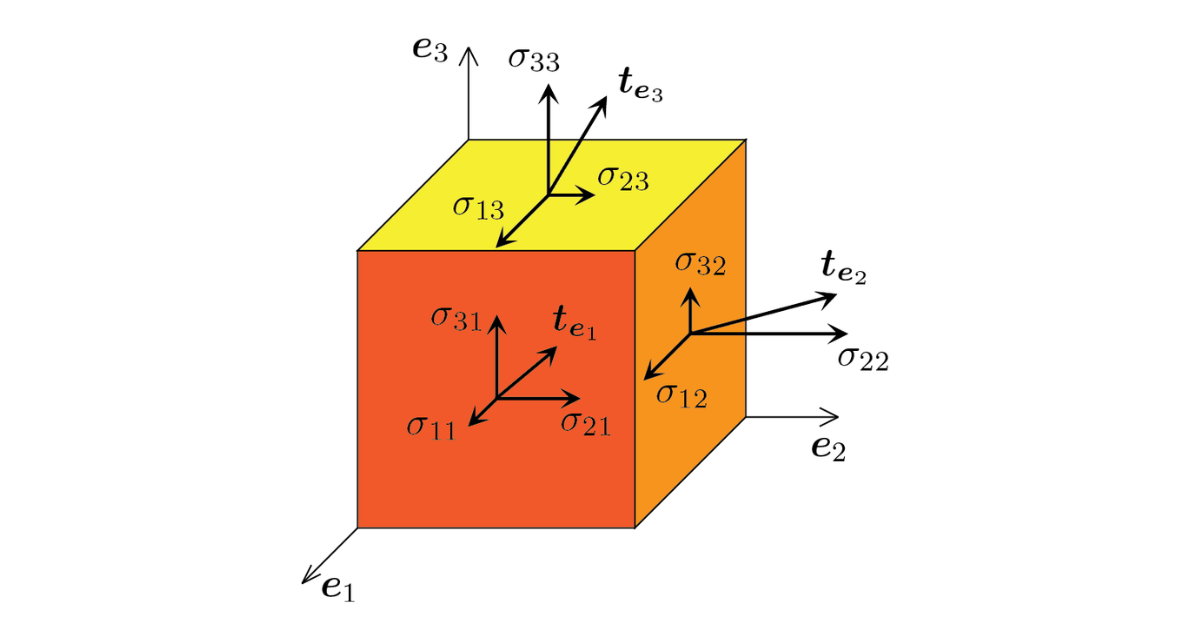
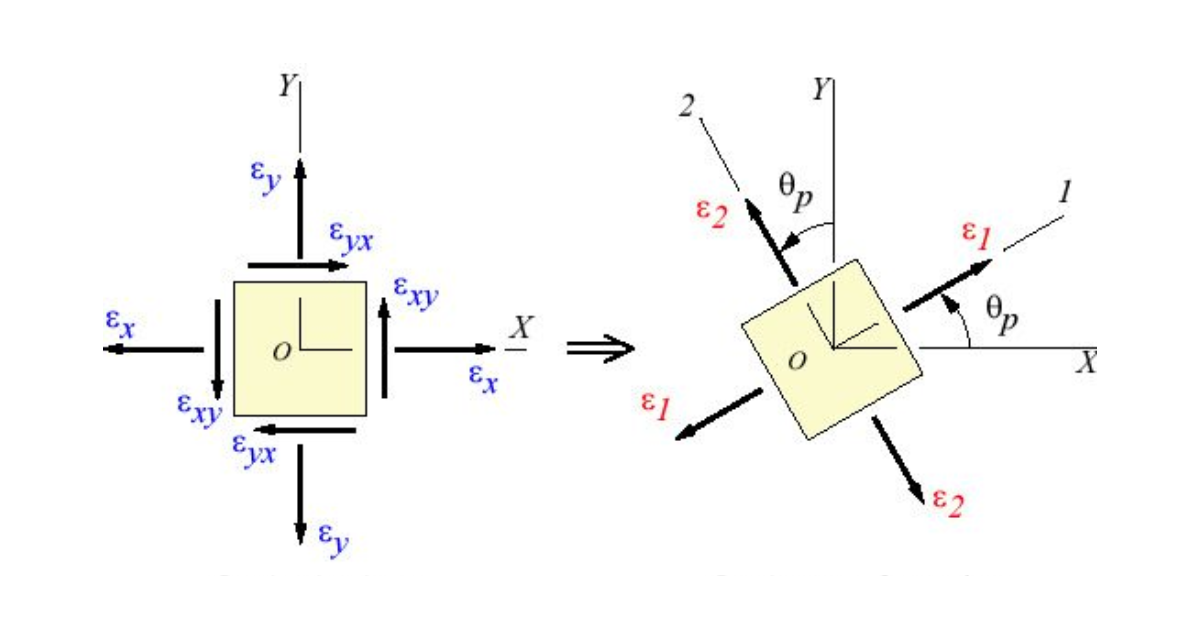
Principal strain represents the maximum and minimum normal strains that occur at a point in a material when it is subjected to external loading. In practical engineering situations, materials are rarely loaded in just one direction; instead, they experience complex, multi axial loading that causes deformation in different directions along with shear distortion. Principal strain helps simplify this complex state of deformation by identifying specific directions where the strain is purely normal, and the shear strain is zero. These values are known as maximum principal strain and minimum principal strain, and they indicate the most extreme stretching and compression experienced by the material.
Strain itself is a measure of deformation and is defined as the change in dimension relative to the original dimension. It is a dimensionless quantity that describes how much a material elongates or contracts under stress. When a material is subjected to two dimensional stress or strain conditions, the principal strains can be calculated using transformation equations derived from strain relationships. These equations provide the maximum and minimum strain values at a point:
The stress strain curve plays a vital role in engineering by providing a comprehensive understanding of how materials behave under different loading conditions. It serves as a foundational tool for safe and efficient design across industries.
Material Selection and Safety: Engineers rely on stress strain data to select appropriate materials for specific applications. By understanding how materials respond to stress, they ensure that structures such as bridges, aircraft, and machine components can safely withstand operational loads without failure.
Design and Failure Prevention: A clear distinction between elastic and plastic regions enables engineers to design components that operate within safe limits. This prevents permanent deformation and ensures long term functionality, reliability, and safety of engineering systems.
Characterization of Material Properties: The stress strain diagram provides critical mechanical properties essential for design and analysis, including:
Component Design Applications: Stress strain relationships are fundamental in designing and analyzing components such as fasteners, gears, bearings, and shafts. These insights help engineers predict performance under load and prevent unexpected failures in service.
Manufacturing Optimization: In manufacturing processes like rolling, forging, and bending, materials are intentionally plastically deformed. Stress strain data helps determine the required forces, optimize process parameters, and ensure product quality while minimizing defects.
The stress strain curve provides a visual representation of how a material responds to loading. Initially, the curve is linear in the elastic region, where stress and strain increase proportionally. At the yield point, the material begins to deform permanently. Beyond this, the material enters the plastic region, where deformation continues even with small increases in stress. The curve reaches its peak at the ultimate tensile strength, after which the material begins to weaken until it finally fractures. This curve is essential for understanding material properties such as stiffness, strength, and ductility.
Different materials respond to stress and strain in unique ways. Metals such as aluminum and titanium exhibit clear yield points and strong mechanical properties. Aluminum offers a good strength to weight ratio but is less resistant to fatigue compared to titanium, which performs better under repeated loading. Plastics vary depending on their type. Thermoplastics can deform and return to shape, making them suitable for flexible applications, while thermosets are more rigid and brittle, offering higher strength but lower strain tolerance. Composites depend heavily on fiber orientation, with strength being highest along the fiber direction. This directional behavior makes them ideal for applications requiring strength in specific directions.
Manufacturing processes significantly influence how materials behave under stress and strain. In 3D printing, the layer by layer construction introduces anisotropy, meaning strength varies depending on the direction of the applied force. CNC machining can introduce residual stresses due to cutting forces, which may affect fatigue life. Injection molding often leads to internal stresses caused by uneven cooling and shrinkage, impacting dimensional accuracy and strength. In sheet metal fabrication, processes like bending and stamping cause strain hardening, increasing strength but reducing ductility. Additionally, grain direction plays a crucial role in determining how the material handles stress.
A practical example of stress and strain can be seen in a bridge carrying traffic. The weight of vehicles creates stress within the structural elements of the bridge. As a result, the bridge undergoes slight deformation, which is the strain. Engineers design bridges so that the stress remains within safe limits and the resulting strain stays within the elastic region. This ensures that once the load is removed, the structure returns to its original shape without permanent damage. If these limits are exceeded, it can lead to structural failure, highlighting the importance of stress strain analysis in civil engineering.
When a crane lifts a heavy load, its structural components experience different types of stress and strain. The steel cable undergoes tensile stress as it supports the weight, causing it to stretch slightly, which is the resulting strain. At the same time, the crane’s boom arm experiences bending and compressive stresses due to the load acting at a distance. These deformations are typically very small and remain within the elastic region, meaning the cable and structure return to their original shape once the load is removed. However, if the load exceeds the crane’s rated capacity, the stress may surpass the material’s yield strength, leading to permanent deformation or even sudden failure, such as cable snapping. This is why engineers carefully design cranes using stress strain data to ensure safe lifting operations under all working conditions.
In mechanical assemblies, tightening a bolt is another practical example of stress and strain in action. When a bolt is tightened, it experiences tensile stress, which causes it to elongate slightly this elongation is the strain. Simultaneously, the components being fastened are subjected to compressive stress, creating a strong clamping force that holds the joint together. This controlled deformation is intentional and critical for maintaining joint integrity. If the bolt is tightened within its elastic limit, it will return to its original length when removed, ensuring reliability. However, over tightening can push the material into the plastic region, resulting in permanent deformation, reduced strength, and potential failure during operation. Engineers therefore specify precise torque values to ensure optimal performance and durability of bolted joints.
Stress and strain are fundamental concepts that define how materials respond to forces. Stress represents the applied force per unit area, while strain measures the resulting deformation. Together, they provide a complete picture of material behavior under load. By understanding their relationship, engineers can select appropriate materials, design safer structures, and predict failures before they occur. Whether in manufacturing, aerospace, automotive, or civil engineering, mastering stress and strain is essential for building reliable and high performance systems.
© 2026 RA Global Tech Solutions
Site design and developed by Rajkar Global